
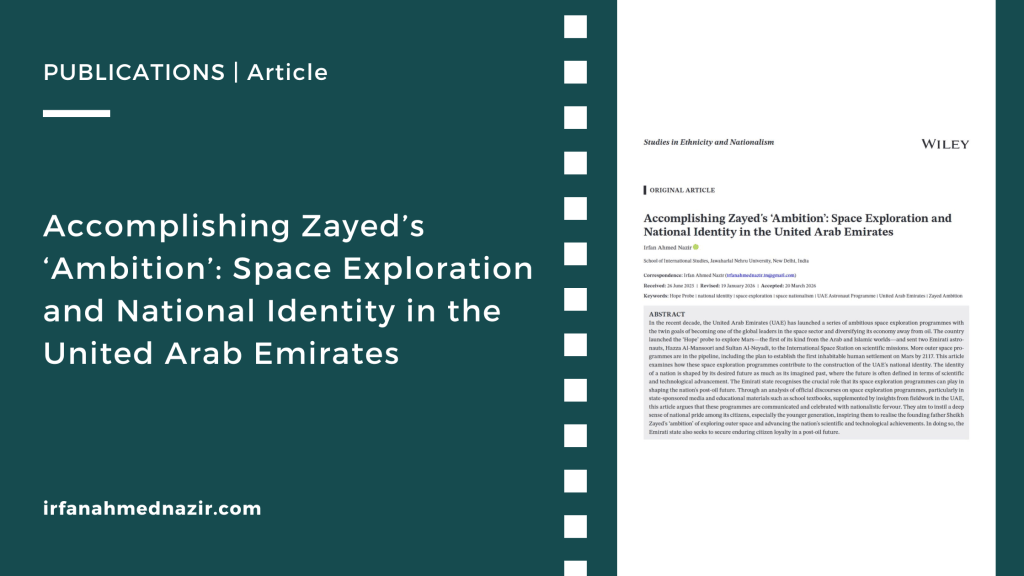
Abstract: In the recent decade, the United Arab Emirates (UAE) has launched a series of ambitious space exploration programmes with the twin goals of becoming one of the global leaders in the space sector and diversifying its economy away from oil. The country launched the ‘Hope’ probe to explore Mars—the first of its kind from the Arab and Islamic worlds—and sent two Emirati astronauts, Hazza Al-Mansoori and Sultan Al-Neyadi, to the International Space Station on scientific missions. More outer space programmes are in the pipeline, including the plan to establish the first inhabitable human settlement on Mars by 2117. This article examines how these space exploration programmes contribute to the construction of the UAE’s national identity. The identity of a nation is shaped by its desired future as much as its imagined past, where the future is often defined in terms of scientific and technological advancement. The Emirati state recognises the crucial role that its space exploration programmes can play in shaping the nation’s post-oil future. Through an analysis of official discourses on space exploration programmes, particularly in state-sponsored media and educational materials such as school textbooks, supplemented by insights from fieldwork in the UAE, this article argues that these programmes are communicated and celebrated with nationalistic fervour. They aim to instil a deep sense of national pride among its citizens, especially the younger generation, inspiring them to realise the founding father Sheikh Zayed’s ‘ambition’ of exploring outer space and advancing the nation’s scientific and technological achievements. In doing so, the Emirati state also seeks to secure enduring citizen loyalty in a post-oil future.
Recommended Citation: Nazir, Irfan Ahmed. 2026. ‘Accomplishing Zayed’s ‘Ambition’: Space Exploration and National Identity in the UAE’. Studies in Ethnicity and Nationalism (Wiley), 3 April.
DOI: 10.1111/sena.70040
 Irfan Ahmed Nazir