
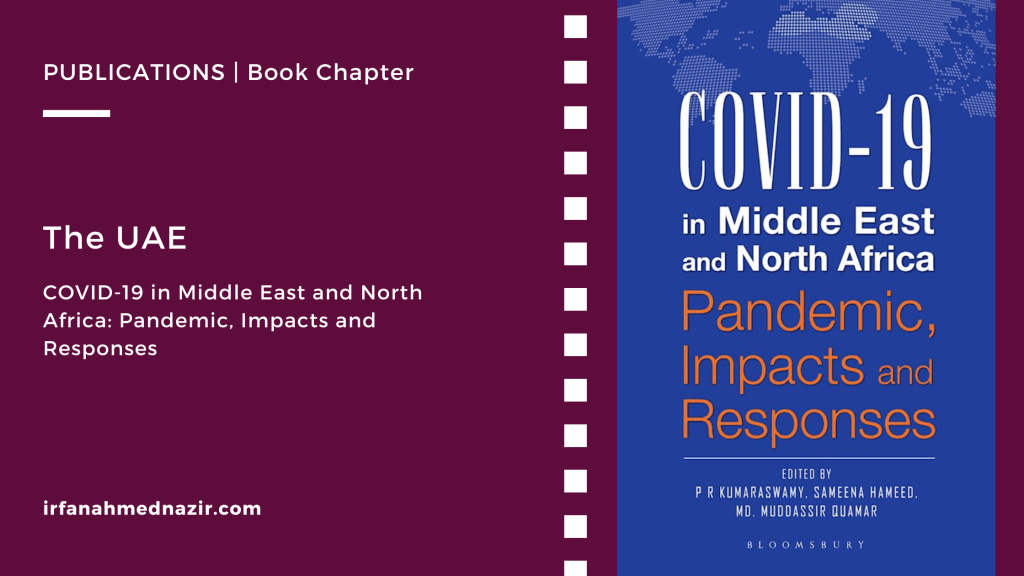
Excerpt: The United Arab Emirates (UAE) is a federation of seven Arab emirates – Abu Dhabi, Dubai, Sharjah, Ajman, Fujairah, Umm Al Quwain and Ras Al Khaimah – situated in the northeastern part of the Arabian Peninsula. Established on 2 December 1971, the UAE has emerged as one of the global hubs for business, trade and tourism, boosted by its enormous oil revenues. More than 200 nationalities live and work in the UAE, demonstrating its rich social, cultural and religious experience. In 2020, expatriates constituted 88 per cent of the UAE population, with Indians being the largest nationality.
The COVID-19 pandemic severely affected the UAE as it heavily relies on the global mobility of goods and people to meet its economic needs and progress. On 29 January 2020, the UAE reported the first confirmed case of COVID-19 in the Middle East and North Africa (MENA) region. As the numbers spiked, the UAE imposed travel restrictions and lockdowns, bringing social and economic activities to a standstill. The authorities postponed the much-awaited Dubai Expo 2020 by one year. Nevertheless, the UAE was able to withstand the crisis due to the proactive measures of the government and successfully hosted the Dubai Expo in 2021 and celebrated the golden jubilee of the qiyam al-ittihad (establishment of the federation) and qiyam al-dawla (establishment of the state) on 2 December 2021 (p. 257)
Recommended Citation: Nazir, Irfan Ahmed. 2025. ‘The UAE’. In COVID-19 in Middle East and North Africa: Pandemic, Impacts and Responses, edited by P.R. Kumaraswamy, Sameena Hameed and Md. Muddassir Quamar, 257–272. New Delhi: Bloomsbury India.
DOI: 10.5040/9789361316951.ch-20.
 Irfan Ahmed Nazir